
↑Mary Christmas
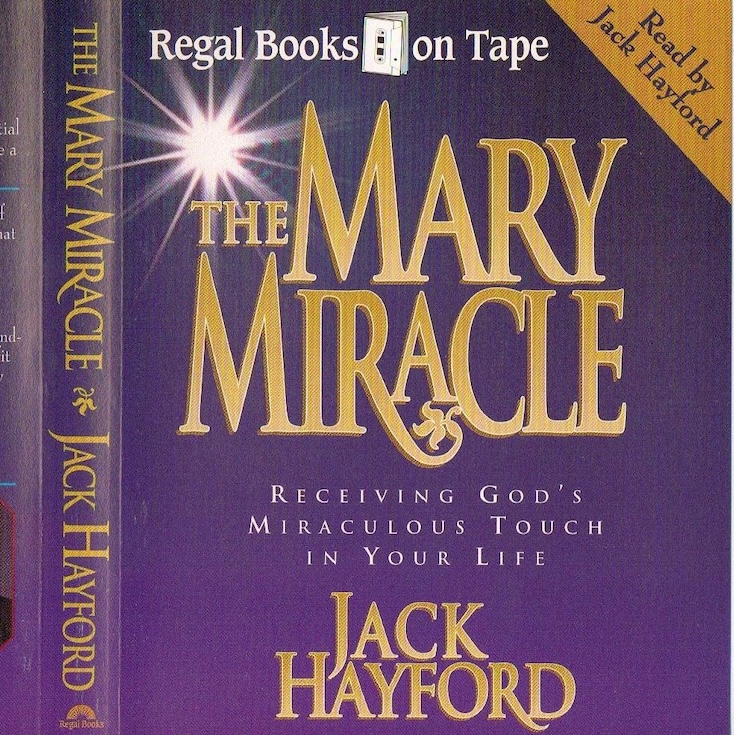
Inspired by Dr Jack Hayford’s insightful book: The Mary Miracle. Mary can teach us much. ⇔
©Michael Krigline, Dec 2013 (edited 2026) ~ krigline.com ⇔
Most Christians know that Jesus’ mother was named Mary, but what do we really know about this woman? Honest inquirers can find helpful principles demonstrated in the woman whom God chose to be the mother of the Messiah. If you are reading this with a group, I’ve included discussion questions to make the message more interactive.
Note: This Christmas-time message was inspired by Dr. Jack W. Hayford’s book, The Mary Miracle. Regal Books, 1997, ISBN: 978-0830717330. As I heard the audio version, I couldn’t record page numbers. The whole book is worth reading.
All Scriptures are from The Holy Bible: English Standard Version. 2001 (Lk 1:26–55). Wheaton: Standard Bible Society.
- Luke 1: 26-45 (presented as “Readers’ Theater”)
- Narrator: 26 In [Elizabeth’s] sixth month the angel Gabriel was sent from God to a city of Galilee named Nazareth, 27 to a virgin betrothed to a man whose name was Joseph, of the house of David. And the virgin’s name was Mary. 28 And he came to her and said,
- Angel: “Greetings, O favored one, the Lord is with you!”
- Narrator: 29 But she was greatly troubled at the saying, and tried to discern what sort of greeting this might be. 30 And the angel said to her,
- Angel: “Do not be afraid, Mary, for you have found favor with God. 31 And behold, you will conceive in your womb and bear a son, and you shall call his name Jesus. 32 He will be great and will be called the Son of the Most High. And the Lord God will give to him the throne of his father David, 33 and he will reign over the house of Jacob forever, and of his kingdom there will be no end.”
- Narrator: 34 And Mary said to the angel,
- Mary: “How will this be, since I am a virgin?”
- Narrator: 35 And the angel answered her,
- Angel: “The Holy Spirit will come upon you, and the power of the Most High will overshadow you; therefore, the child to be born will be called holy—the Son of God. 36 And behold, your relative Elizabeth in her old age has also conceived a son, and this is the sixth month with her who was called barren. 37 For nothing will be impossible with God.”
- Narrator: 38 And Mary said,
- Mary: “Behold, I am the servant of the Lord; let it be to me according to your word.”
- Narrator: And the angel departed from her. 39 In those days Mary arose and went with haste into the hill country, to a town in Judah, 40 and she entered the house of Zechariah and greeted Elizabeth. 41 And when Elizabeth heard the greeting of Mary, the baby leaped in her womb. And Elizabeth was filled with the Holy Spirit, 42 and she exclaimed with a loud cry,
- Elizabeth: “Blessed are you among women, and blessed is the fruit of your womb! 43 And why is this granted to me that the mother of my Lord should come to me? 44 For behold, when the sound of your greeting came to my ears, the baby in my womb leaped for joy. 45 And blessed is she who believed that there would be a fulfillment of what was spoken to her from the Lord.”
PAUSE TO PONDER: Pick one verse or passage above, and explain why it stands out to you.
Merry Christmas!
You have just read the way the Bible introduces Mary to us. If you can forget about the Christmas songs, plays, movies and other things that so often shroud the Bible’s simple message with tradition and folklore, you have to admit that we really don’t know much about this remarkably favored woman. In a few moments, we’ll hear Mary’s Spirit-filled response to Elizabeth’s greeting (known as the Magnificat). But other than that, the Bible does not have a lot to say about Mary. You can basically put everything we know about Mary on just a few pages. Here’s what we know:
Mary stayed with her relative Elizabeth in “a town in Judah” for about three months, then (now three months pregnant) returned home to the small town of Nazareth (Luke 1:56). When Mary “was found to be with child from the Holy Spirit” (Matt 1:18), an angel appeared in a dream and talked Joseph out of divorcing Mary. Anything we imagine about Mary’s response is just that—imagined. Yes, the family members of an unwed, pregnant teen probably had a wide range of emotions and anguished conversations, but they could have responded with great faith and excitement. We are simply not told anything about them.
PAUSE TO PONDER: Most dramas present distraught relatives. Imagine instead a faith-filled family. How might they have reacted to Mary? Speculate on what God might have done to help the family to believe?
Next, a Roman census makes Mary and Joseph head 100 miles south to be registered in Bethlehem (Luke 2:1-4). We’re not told anything about a donkey, or a stable, or how long they were in Bethlehem before the birth, but “while they were there” (Lk 2:6) Mary gave birth. When the shepherds arrived, saying that angels had made the delivery announcement, they “found Mary and Joseph, and the baby lying in a manger” (Lk 2:8-20). And all we’re told about Mary is that she “treasured up all these things, pondering them in her heart” (Lk 2:19).
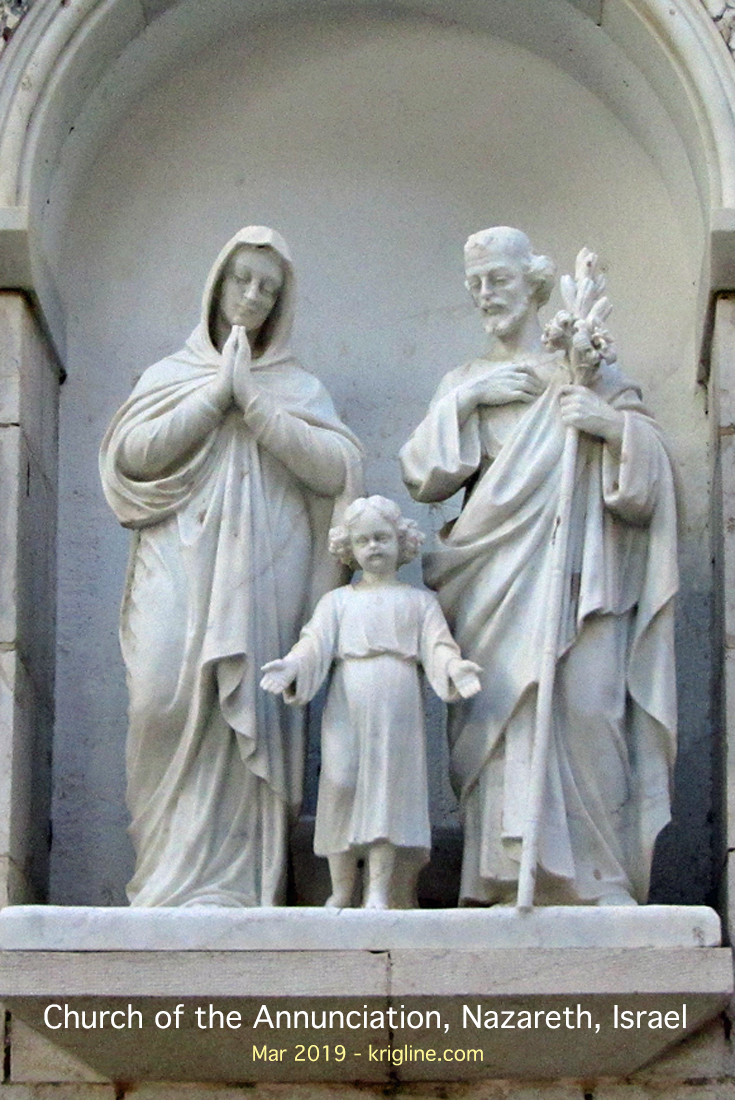
We assume that they stayed in Bethlehem over a month, for when Jesus was 40 days old, we see the family at the Temple in nearby Jerusalem, offering “a pair of turtledoves, or two young pigeons” (Luke 2:24); this is how we know they were poor, for the required sacrifice for wealthy people was much more expensive. While in the Temple, they were encouraged by a prophetess Anna, and a prophet Simeon (a “devout and righteous man” who hung out at the Temple) told Mary of the child’s destiny, and added: “and a sword will pierce through your own soul also” (Luke 2:35) —hardly the thing a new mother wants to hear about her baby, but I’m sure those words brought comfort and understanding later.
If you thought that the “wise men” arrived the same night Mary arrived in Bethlehem, meeting the shepherds beside a manger… well, sorry, that’s not what the text says. In fact, the text says the family returned to Nazareth after the dedication in Jerusalem (Luke 2:39), but maybe just for a visit for they are back in Bethlehem when the Magi arrive, perhaps a year later. We estimate the time, in part, because Matt 2:11 uses the Greek word for toddler/child not baby: “And going into the house [not stable] they saw the child [not baby] with Mary his mother…”, and then they worship Jesus and present their gifts. Soon thereafter, Joseph (not Mary) sees another angel in a dream, who says (Matt 2:13) “take the child and his mother, and flee to Egypt…”, where they stay (we’re not told how long—maybe days, maybe years) until Joseph’s final angelic dream informs them that King Herod is dead. Then they return to “their own town of Nazareth” (Lu 2:39).
PAUSE TO PONDER: Historians say Nazareth was a relatively new town, having been re-settled only 100-200 years before the birth of Jesus. Therefore, it didn’t exist in the time of the prophets. Located on a high hill above the Megiddo valley, the population was likely under 500 (compared to 30,000 in nearby Sepphoris[1]). Although we can’t know for certain, why might the family have traveled from the temple to Nazareth, and then back to Bethlehem, before eventually raising Jesus in Nazareth?
Mary appears in the Bible again when Jesus is 12, about a year before Jesus “comes of age.” This is the only picture we have of Jesus’ formative years. Luke (2:48) tells us that Jesus apparently decided to stay at the Temple in Jerusalem, without telling his parents. When Mom and Dad finally find Jesus three days later, Mary gets her fourth “direct quote” in Holy scripture:[2] “Son, why have you treated us so? Behold, your father and I have been searching for you in great distress.” To which Jesus replied: “Why were you looking for me? Did you not know that I must be in my Father’s house?” Luke adds: “And they did not understand the saying that [Jesus] spoke to them. And Jesus went down with them and came to Nazareth and was submissive to them. And his mother treasured up all these things in her heart” (Luke 2:50-51).
We don’t hear from Mary again for almost 20 years. Her final “direct quote” comes at a wedding in Cana, when Mary sort of prompts Jesus to perform his first miracle, turning water into wine for the wedding feast. The text simply says:
When the wine ran out, the mother of Jesus said to him, “They have no wine.” And Jesus said to her, “Woman, what does this have to do with me? My hour has not yet come.” His mother said to the servants, “Do whatever he tells you” (John 2:3-5).
This quotation alone gives us reason to honor Mary. That’s probably the clearest, shortest summary of Christian doctrine in the Bible, and remarkable advice no matter what the occasion. As the New King James version puts it: “Whatever He says to you, do it.” The results were great, for John tells us: “This, the first of his signs, Jesus did at Cana in Galilee, and manifested his glory. And his disciples believed in him.” (Way to go, mom!)
Then the Bible barely mentions Mary throughout Jesus’ three-year public ministry. John 6:42, Matt 13:55 and Mark 6:3 tell us that the neighbors (near Lake Gennesaret and in Nazareth) know both Mary and Joseph. It’s here, not the nativity story, where we learn that Joseph is a carpenter (Matt 13:55, Mark 6:3).[3] These passages also tell us that Mary and Joseph had more children, namely Jesus’ “brothers James and Joseph and Simon and Judas,” as well as unnamed sisters—a big family for a carpenter at the time. We get a glimpse of the big, happy family in John 2:12, which says that, after the wedding in Cana, Jesus “went down to Capernaum, with his mother and his brothers and his disciples, and they stayed there for a few days.”
PAUSE TO PONDER: How did infant mortality, a parent’s profession, location, medical care, and other factors affect family size in the first century? What factors affect family size today?
At some point, however, Jesus’ family was apparently having misgivings about Jesus, or at least about his sanity. John 7:5 says: “For not even his brothers believed in him.” Mark also talks about a time when big crowds were gathering around Jesus, who had just appointed the 12 “to preach and have authority to cast out demons.” The text says: “And when his family heard it, they went out to seize him, for they were saying, ‘He is out of his mind’” (Mark 3:20-22). We don’t know if Mary agreed with the family, but 10 verses later, Jesus is told, “Your mother and your brothers are outside, seeking you.” We are not told if Jesus even pauses to talk with them; Jesus simply looks at the disciples sitting around him, and replies: “Who are my mother and my brothers? 34 Here are my mother and my brothers! 35 For whoever does the will of God, he is my brother and sister and mother” (Mark 3:31-35).[4]
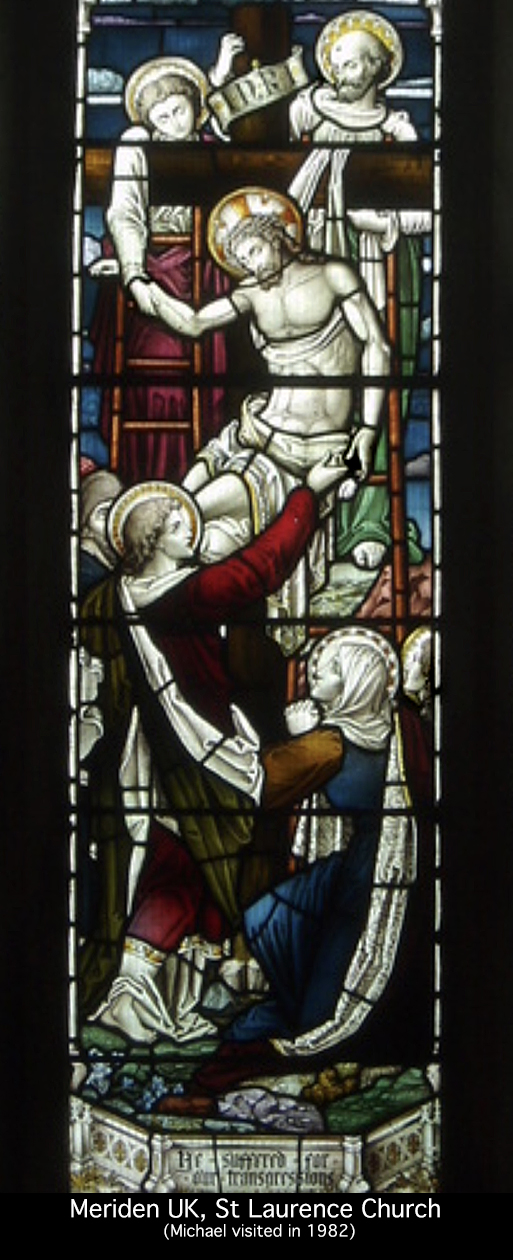
Sooner or later, at least some of them came to believe who Jesus was, for Acts 1:14 has “his brothers” present in the post-ascension Upper Room. We also know that Jesus’ half-brother James was one of the leaders of the Early Christian Church. The New Testament contains letters from two of Jesus’ half-brothers: James and Jude.
Furthermore, John 19:24 tells us that Mary was “standing by the cross of Jesus” when they crucified her son (fulfilling Simeon’s prophecy, to be sure). Jesus speaks to Mary from the cross: “Woman, behold your son!” and then commends her to the care of John, “the beloved disciple” —and tradition says that she ended her days in John’s care, in the city of Ephesus.
Perhaps Mary was also one of the Mary’s who went to the tomb on that first Easter; the text is not definitive.[5] Regardless, we see Mary for one last time, in Acts 1:14, among the disciples in the Upper Room, just after Jesus ascended into heaven. The author, Luke, tells us: “All these with one accord were devoting themselves to prayer, together with the women and Mary the mother of Jesus, and his brothers.”
That’s all we know about Mary. She isn’t mentioned once in the epistles. We have no stories of people asking her to take some need to Jesus, and no scriptural indication that she was superhuman in any way. Although greatly favored by God, Mary as presented in the Bible was just a common girl, from a religious family, who trusted and submitted to a very big God.
PAUSE TO PONDER: What do you think Simeon meant when he prophesied: “and a sword will pierce through your own soul also” (Luke 2:35)? If you were making up a fictional story about a hero, would you include an account in which family members think the hero is crazy? Why or why not?
The only information about Mary omitted above is the Magnificat in Luke 1. This remarkable “song of praise” deserves special attention. The angel had told Mary that Elizabeth, her relative, was six-months pregnant—something that Mary may or may not have already known, but the angel’s words seem to have prompted Mary to pay Elizabeth a visit. Elizabeth prophetically confirms that Jesus will be the Messiah, which must have been a huge confirmation of the angel’s words. Out of all the women who would ever live, why did God choose Mary? Her spontaneous Magnificat may reveal part of the answer, for this was a woman who loved God, and knew His Word. And this is amazing for the first century. In the synagogues, women were separated from the men (and the Holy Books) by a screen. Back there with the other women and children, it was likely difficult to hear the teachings. Furthermore, Jewish men of the first century prayed, “I thank Thee God that Thou hast not made me a woman.” And the Jewish Talmud said it was better to burn the Torah [i.e., scriptures] than to teach it to a woman.
As we examine Mary’s song, we see that somehow Mary was not shackled by these notions, which might also tell us something about her mother and father. We assume that her Dad taught her the scriptures at home (just as parents should do today). But this much is clear: God Almighty saw something special in this teenage Jewish virgin. And once she gave God permission—by telling the angel, “I am the servant of the Lord; let it be to me according to your word”—God performed a miracle. To quote Pastor Jack Hayford: “God’s redemptive promise was brought to her, to grow in her, to be delivered through her, to change the world around her.”
Here is Mary’s song, and to give you an idea of how well Mary knew her Bible, each phrase is paired with a related Old Testament scripture.
- Mary’s Song of Praise: The Magnificat – Luke 1:46-55 ESV
- 46 “My soul magnifies the Lord,
- OT 3 Oh, magnify the Lord with me, and let us exalt his name together! 4 I sought the Lord, and he answered me and delivered me from all my fears. (Ps 34:3-4)
- 47 and my spirit rejoices in God my Savior,
- OT I will rejoice in the LORD; I will take joy in the God of my salvation. (Hab 3:18)
- 48 for he has looked on the humble estate of his servant.
- OT For though the Lord is high, he regards the lowly, but the haughty he knows from afar. (Ps 138:6)
- For behold, from now on all generations will call me blessed;
- OT Her children rise up and call her blessed; her husband also, and he praises her…” (Pr 31:28)
- 49 for he who is mighty has done great things…
- OT The Lord your God is in your midst, a mighty one who will save; he will rejoice over you with gladness; he will quiet you by his love; he will exult over you with loud singing. (Zep 3:17)
- 49 he …has done great things for me,
- OT The Lord has done great things for us; we are glad. (Ps 126:3)
- and holy is his name.
- OT For thus says the One who is high and lifted up, who inhabits eternity, whose name is Holy: “I dwell in the high and holy place, and also with him who is of a contrite and lowly spirit, to revive the spirit of the lowly, and to revive the heart of the contrite. (Is 57:15)
- 50 And his mercy is for those who fear him…
- OT O Lord, let your ear be attentive to the prayer of your servants who delight to fear your name, and give success to your servant today, and grant him mercy in the sight of this man. (Neh 1:11)
- who fear him from generation to generation.
- OT May they fear you while the sun endures, and as long as the moon, throughout all generations! (Ps 72:5)
- 51 He has shown strength with his arm;
- OT Awake, awake, put on strength, O arm of the Lord; awake, as in days of old, the generations of long ago. (Is 51:9)
- he has scattered the proud in the thoughts of their hearts;
- OT The pride of your heart has deceived you, you who live in the clefts of the rock, in your lofty dwelling, who say in your heart, “Who will bring me down to the ground?” (Obad 1:3)
- 52 he has brought down the mighty from their thrones and exalted those of humble estate;
- OT thus says the Lord God: Remove the turban and take off the crown. Things shall not remain as they are. Exalt that which is low, and bring low that which is exalted. (Eze 21:26)
- 53 he has filled the hungry with good things, and the rich he has sent away empty.
- OT For he satisfies the longing soul, and the hungry soul he fills with good things. (Ps 107:9)
- 54 He has helped his servant Israel, in remembrance of his mercy,
- OT But you, Israel, my servant, Jacob, whom I have chosen, …saying to you, “You are my servant, I have chosen you and not cast you off”; fear not, for I am with you; be not dismayed, for I am your God; I will strengthen you, I will help you, I will uphold you with my righteous right hand. (Is 41:8–10)
- 55 as he spoke to our fathers, to Abraham and to his offspring forever.”
- OT You will cast all our sins into the depths of the sea. You will show faithfulness to Jacob and steadfast love to Abraham, as you have sworn to our fathers from the days of old. (Mic 7:19–20)
PAUSE TO PONDER: Pick one verse or passage above, and explain why it stands out to you.
Many alternate passages could have been quoted, but you get the point. There are at least a dozen themes in Mary’s song: joy, salvation, humility, victory, blessing, God’s power, trial, service, faithfulness, mercy, promise, provision…. These Biblical ideas didn’t just pop into Mary’s head. God’s Word pours out of us because we’ve taken the time and energy to pour it in. The Holy Spirit continuously performs the same miracle in every Christian’s life, reminding us of verses at just the right time. But God can’t remind us of things we’ve never read, and that is a key point of application from this article. We all need to invest in learning, singing, studying and re-reading God’s Word.
If you are reading this as a teen or child, you’re not off the hook! Scholars think that Mary was probably just a teenager when all of this happened—and do you see how much Scripture she already knew? Don’t you want God to help you make GOOD choices in your studies, relationships, and career plans? Don’t you want the Holy Spirit to guide you into a life that will be fulfilling and meaningful? Start now, by giving Him the tools by which He will lead you.
God’s Word pours out of us because we’ve taken the time and energy to pour it in.
In The Mary Miracle, Pastor Jack Hayford writes that there are many other things we can learn from Mary. He calls Mary a prototype of God’s workings with all Christians; that is, all who humbly say to God: “Behold, I am the servant of the Lord; let it be to me according to your word” (Luke 1:38).
First, “Mary knows how to respond when God offers miracles. She welcomes His wonder-workings” (Hayford[6]).
Second, she also knows what to do when angels or people give you a prophecy about your life; Mary doesn’t push for the prophecy’s fulfillment, but considers it carefully in her heart and patiently leaves it in God’s hands.
Third, Mary teaches us that God is not afraid of honest questions like “How can this be?”
And fourth, Mary is an example of a long walk in faith. How could anyone watch Jesus grow up, die, rise again, and ascend to heaven without times of confusion and questions? Whether or not Mary was part of the “family” who thought Jesus was “out of His mind” (in Mark 3:20), we nonetheless find her at the foot of the cross and in the Upper Room after His ascension (John 19:24; Acts 1:14); and tradition says she remained a faithful disciple until she died.
PAUSE TO PONDER: A welcoming response, patiently trust God’s plan, ask honest questions, take the long walk in faith; which of these best characterizes your life in Christ? Can you add another thing we learn from Mary?
Did you notice that the Bible used the word “conceive” for both Elizabeth’s and Mary’s pregnancy? We still say that babies are “conceived,” but we also talk about ideas and plans being “conceived”—whether it is a plan to prepare for a certain career, or an idea related to your family, church or business.
Similarly, the word “deliver” can refer to a baby, but it also refers to someone who needs to be saved or set free. In the words of Mark Lowry’s beloved Christmas song: “Mary did you know…the Child that you delivered, will soon deliver you.”
These concepts—conceive and deliver—“converge” in the heart and the womb, “the two parts of the human anatomy that convey life” (Hayford).
God designed us all to be able to “conceive” things that will advance the Kingdom of God, and then “carry” them through to delivery. Yes, this includes spiritual things like teaching children on Sundays, preaching, sharing your faith, and the like, but God can also help you “conceive” how to:
- save time running your home or business
- save money at work or home
- study more productively
- overcome some handicap
- meet someone’s special need.
When we conceive of such things, or help anyone be delivered from sin or the burdens of life, isn’t that an act of the Holy Spirit? Isn’t that “the Mary miracle” being performed today?
PAUSE TO PONDER: Give an example of a plan or idea God helped you to conceive of (can be big or small), or a way God has used you to deliver someone from a burden. Comment about the idea that conceiving of things and being delivered are examples of miracles.
Of course, the purpose for God’s miraculous blessings have been clear from the beginning of Genesis: “I will make of you a great nation, and I will bless you and make your name great, so that you will be a blessing. …In you all the families of the earth shall be blessed” (Gen 12:2-3). God helps us conceive and receive blessings so that we can bless others.
If we are like Mary, we might look at our situation and wonder: “How can this be? (Luke 1:34.) How could God do something through me that could be a blessing to others?” When we don’t have the resources to do, or be, what we know God is calling us to, we need to remember the angel’s reply to Mary’s honest question: “The Holy Spirit will come upon you, and the power of the Most High will overshadow you” (Luke 1:45).
If God conceives something in you, He will provide the miracle needed to bring it to delivery. But remember that Mary’s response was pivotal. God seeks our willing, loving surrender to His ways, in faith.
To be sure, Jesus had not chosen a fool to be his own mother, and in that eternal moment before Mary replied to the angel she must have wondered about the cost—to herself, Joseph, her family. We too must count the cost. When others see God’s blessings in our lives, some will rejoice (like Elizabeth), but others may be jealous, vicious or skeptical. Jack Hayford says, “I’ve never known miracle grace to be revealed from God’s hand, apart from the loss of face.” This cost shouldn’t surprise us, for salvation itself comes only to those who humbly admit before God that we are helpless to save ourselves apart from Jesus’ sacrifice, power and grace.
And if you have never bowed your soul to the Almighty, receiving the salvation Christians celebrate each time we take Communion, there’s no better time than now to get right with God. If I’m talking to you, stop reading and pick up a phone to call your pastor or a Christian friend. It could be the most important moment of your life.[7]
If humility is required for salvation, should we expect less of the modern miracles God conceives in our hearts—miracles that will bring recovery, restoration, revival, or the release of resources needed to effect the delivery of people from evil?
PAUSE TO PONDER: What does this section say about the role of Holy Spirit? Why do you think it is so hard for people to humbly admit that we need God to save us? Talk about a “cost” you (or someone you know) has paid to be a faithful Christian.
If you are willing to let God “birth” his dreams through you, Mary can teach you how to handle this “spiritual pregnancy.”
- Mary’s first step was to serve someone else’s miracle.
- Mary sang a scripture-filled song as the miracle stretched her body and soul.
- Mary didn’t defend or explain her miracle to anyone.
First, Mary went to serve someone else’s miracle. The Bible says she went “with haste” to take care of a much older relative (Elizabeth), who was surely helped in countless ways by this young woman. We know very little about how Mary reacted to Gabriel’s news, but I picture her running home and saying:
- “Mom, an angel told me that Aunt Elizabeth is pregnant, so I’m heading south in the morning.”
- “Elizabeth? Could this be”
- (If Mom only knew what else the angel said!)
What a confirmation it would have been just to step off the train—donkey train or camel train, of course—and see Elizabeth’s round belly. In the process, Mary also learned from someone whose miracle was a little further along than hers. That is service and mentorship—a powerful combination.
Next, Mary received a song to sing; and there’s nothing like scripture-filled music to nurture a heavenly vision. Surely, we know the Magnificat today because she sang it over and over in the months that followed. Just as normal pregnancy wearies and stretches the body and soul, giving spiritual birth does the same. Mary’s way to deal with that was to sing. Internet radio is good, but don’t neglect the time-tested hymns and divinely inspired Psalms. You might even “sing a new song,” like Mary. Remember that we said there are a dozen biblical themes in Mary’s song, and we need them all! But if you study the Magnificat, you’ll see Mary’s focus on the central fact: “God is the source of my miracle.”
Mary’s third tip for dealing with spiritual pregnancy is to be free from the burden to understand or explain a miracle blessing to anyone. Has God spoken to you, or even hinted at a vision for your life? Good, keep it to yourself. Don’t be like the “spiritual” guy I knew in college who told a young lady: “God told me that you and I are going to be married.” (She had not received the same vision.) Let God process things in His time and way. We don’t see Mary trying to protect herself or explain this, even to Joseph; God took care of that. She didn’t advertise this miracle, but God aligned the heavens to proclaim it, even to wise men in a foreign culture.
Mary’s way to “carry” the miracle was to “serve, sing, and keep simple of soul” (Hayford).
PAUSE TO PONDER: Which lesson from Mary’s life strikes you most deeply? Talk about the special power God has given to music.
One other verse in Mary’s introduction always grabs me: Luke 1:38 simply says: “And the angel departed from her.” Just because God conceives some plan or project in your heart, don’t expect God to surround you with continual supernatural confirmation. The angel left. After an encouraging time with Elizabeth, Mary faced a return to parents and Joseph in a small village, with a round belly but no explanation; was she thinking, “Where are angels when you need them?” As far as we know, Mary never saw another angel for the rest of her life. But God used normal humans to do angelic work. He used Elizabeth and her husband-priest Zachariah to coach Mary as she served their family. God used humble shepherds, Simeon and Anna at the Temple, and the Gentile wise men.
Similarly, God wants to use you and me to confirm and bless others as they “carry” their little miracles, often without us ever knowing we’re doing it. During a low moment, we’ve all unexpectedly received a stranger’s kind word or a smile while shopping, or an encouraging phone call or text message. We bless each other when we help a friend relocate or care for someone ill. When you share a musical or artistic gift, God can use it to bless both friends and strangers. Think of all the people at your church who serve food, sing, teach, help with sound and electronics, participate on clean-up days, etc. And these are just a few of the everyday “Mary Miracles” that come to mind. If we’ll make time to listen to each other, we will hear about a lot more of the big and little miracles God still does among us.
God used normal humans to do angelic work.
Perhaps you are asking, “What about me? Where are the signs that God is doing or wants to do something in or through me?” If so, you might find answers in the following questions.
(1) Are you reading God’s Word regularly and allowing God to speak to you? Don’t expect an angel to show up, but God does want to speak to you. However, just like any friendship, we can’t expect God to influence our lives if we never take time to be with him. Christianity is more than a set of teachings to follow; it’s a relationship with the One who often graciously speaks through his Word.
(2) Are you using the gifts you already have to serve God now? The teenage Mary didn’t fritter away her time playing computer games and watching reruns—not only because they didn’t exist, but because not even God “can steer a parked car”. That is, God often directs us as we serve, not before we serve. Don’t let the culture dictate what you do with your time. Instead, ask God to help you respond to someone’s need, in your family, church, school or community.
(3) Are you in regular fellowship with other believers? This might be a formal mentorship, but more likely it’s just participation in a small fellowship, group prayer time, regular coffee/lunch meetings with a Christian friend, or something like that. Remember, among Mary’s first steps was to serve someone else in the fulfillment of their dream. God often chooses to guide, direct and encourage us through our Christian brothers and sisters. If you are trying to handle life, or your dreams, on your own, you are missing out on the blessings available to you as a member of the Body of Christ.
PAUSE TO PONDER: If you have ever received help in an unexplainable way, or have had an encounter with an angel, tell us about it. Which of these three questions stands out to you, and why?
Maybe you are doing all those things, but still feel like God has you “on the shelf”. Perhaps you think, or know, you heard from God about some vision or plan, but now it looks like nothing is happening. Well, be patient. How many months did Mary carry her miracle before seeing the fruit of her womb? How many times, especially in those first few days, did she fall asleep dealing with doubts and fears? What sustained her in those six months between Joseph’s confirming dream and the visit of the shepherds with news from heaven? Maybe you set out to fulfill what God conceived in you, but then you started having morning sickness, or you heard that you’d have to walk 100 miles (160 km) to Bethlehem—while 9 months pregnant. Oh, where are the angels when you need them? Be patient, and stay close to Him. And even if your old dream is dead, for whatever reason, God is still willing and wanting to do the miraculous in and through you.
So, in conclusion, we’ve seen that Mary’s song was filled with scripture. We’ve seen that Mary is a prototype for what God still wants to do through us: conceive of ways to bless our world, submit to God, and carry them to delivery. We’ve seen that Mary’s way to “carry” the miracle was to “serve, sing, and keep simple of soul.” Although angelic messengers are rare, we’ve seen that God wants to use you and me as messengers to encourage his faithful servants, often without us even knowing we’re doing it. And finally, hopefully you now see that we are all candidates for a miracle; indeed, God wants to give birth to blessings through each of us, if we are just willing to abide humbly in relationship with Him.
- Mary is a prototype of the obedient servant
- Mary’s way: serve, sing (scripture), and keep simple of soul
- Mary was helped by angelic and human “messengers”
- “The Mary Miracle” can happen to each of us
If you’ve enjoyed reading this article, you should get a copy of The Mary Miracle (see footnote 6). Listen again to Jack Hayford’s words about Mary:
“God’s redemptive promise was brought to her, to grow in her, to be delivered through her, to change the world around her.”
Jack Hayford
God wants to do the same through us, today, wherever we live. Hayford defined a miracle as “any invasion of earth with the workings and grace of Heaven’s power, love and life.” Do you qualify for such a miracle? If you are a Believer, the answer is “yes!” In a way, it can be Christmas all year round for Believers, because “Heaven is still waiting to pour promise into earth’s most unlikely places” (Hayford). Mary was just a common person, with an obscure past, from a poor family—and if God can pour life and promise through her to change the world, God can do the same, in big and small ways, through me and you.
PAUSE TO PONDER: What final comments or questions do you have about this article? Name one thing about Mary that, perhaps, you had never thought of before.
- [1] Sepphoris is not mentioned in the Bible, but archaeological digs around this large city provide insights about the times in which Jesus lived four miles away in Nazareth.
- [2] The Bible has no direct quotations from Joseph.
- [3] The Greek word is “tekton,” which can mean builder, craftsman, or artisan, generally implying work with wood.
- [4] Luke 8:19 & Matt 12:46 may be parallel passages, or may record additional times when Mary and Jesus’ brothers came to visit Him.
- [5] Mark 16:1 and Luke 24:10 say “Mary the mother of James” went to the tomb—this is probably “James and John” since Luke writes “Mary the mother of Jesus” in Acts 1:14, but Jesus did have a brother named James.
- [6] This and other quotes are from Dr. Jack W. Hayford’s book, The Mary Miracle, Regal Books, 1997, ISBN: 978-0830717330
- [7] For more information about Christianity, check out www.ccci.org/whoisjesus/interactive-journey
Vocabulary (mainly for English-language learners)
- crucify: to put to death (literally or figuratively), specifically by nailing a man’s hands & feet to a wooden cross (a common way that Romans killed prisoners in the first century)
- formative years: the time when your character (or sense of morality) develops
- to mentor/mentorship: to teach or tutor someone (over a period of time) who has less education or experience than you have (e.g., an adult man spending time with a fatherless boy or a skilled worker showing a new worker how to complete a complicated task)
- sacrifice: most religions practice “ritual sacrifices” whereby a “pure” animal, or other food, is offered to God, either out of reverent obedience, acknowledgment of the seriousness of sin, or to try to win God’s favor; by extension, today “sacrifices” are things you give up (e.g., your desires, safety, or even your own life) in order to help others (such as the choice to teach poor children for less money than you would make at a “rich” school)
- servant: Mary called herself “the servant of the Lord” and the text calls us to “serve” one another; in such serving, the “servant” humbly considers someone else’s will or need as more important than his/her own. The first step of the Christian faith is to acknowledge that God is so much greater than I am that I should rightfully serve him; but the amazing thing is that the Christian God loves to serve us too, and calls us to serve one another.
For more information about Christianity, check out https://peacewithgod.net/
Original content ©Michael Krigline, including photos/illustrations if noted. For contact info, visit About Us. For privacy info, permissions info, or to make a contribution, see our Website Standards and Use Policy page (under “About Us”). This resource was created/posted under our understanding of “fair use” for educational resources. [Titles that start with ↑ point to devotional articles that help us “look up”.]